[ad_1]
Even as Delhi reports a rising number of dengue and malaria cases, anti-mosquito drives have been impacted by a strike by field workers of the public health department, now in its third week.
According to the Municipal Council Department (MCD)’s vector borne diseases report, dated October 13, 79 new dengue and 63 new malaria cases have been reported in the preceding weekly cycle (ending on October 11), taking the overall case count to 919 cases of dengue and 494 of malaria. So far, officially, no deaths have been confirmed for either dengue or malaria.
The monthly distribution data suggests that the number of cases being reported has increased in the first half of October. For dengue, 160 cases have been confirmed in the first 11 days of October compared to 260 cases in entire September and 208 cases in August.
Similarly, one fourth of the annual malaria caseload this year has been reported in the first 11 days of October alone, with a 123 cases. In comparison, 52 cases of malaria were reported in July, 100 in August, 136 in September.
The report further shows that a large number of cases have also been categorised as untraced — where the information about the patients, such as addresses, is incomplete, or where the infection could have been acquired from another state.
While there are 919 confirmed cases of dengue, there are 833 cases with incomplete addresses, 222 cases where patients could not be traced, and 274 cases where patients had travel history. Overall, there had been 2,115 cases of dengue in 2024, 3,535 in 2023, 902 in 2022 and 35 in 2021.
There are 494 confirmed malaria cases, while another 348 cases fall under the other category. In total, Delhi had registered 511 cases in 2024, 268 cases in 2023, 104 cases in 2022 and 84 cases in 2021.
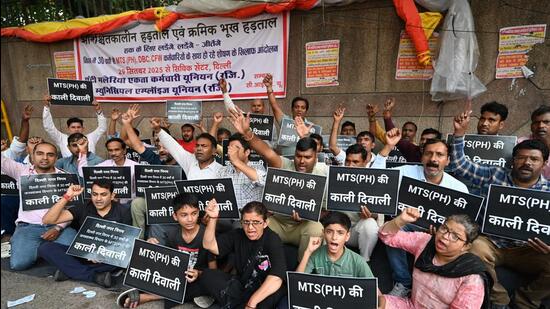
Meanwhile, a strike of the domestic breeding checkers (DBCs) — the field workers of the public health department — entered its 21st day on Sunday. The workers are demanding equal pay, compensatory employment for the family members of these multi-task staff (MTS) workers who die before their retirement, and the provision of medical and earned leaves.
The public health department had not responded to HT’s request for comment till the time that this report was going to print.
The strike has severely affected counter measures. Data from the MCD shows that around 75,356 house visits were made in the last week, ending on October 11, compared to over 9.43 lakh visits made in the week, ending on September 27. In the week before the strike, 11,307 mosquito breeding sites were detected, as compared to 1,102 sites in the last seven-day till October 11.
Around 3,500 DBC workers have been employed with the MCD since 1996. They are the primary foot soldiers of the corporation in the fight against the mosquito-borne diseases. Not only are they responsible for checking and destroying breeding sites, such as water coolers, fountains, and water tanks inside houses, but also help carry out fumigation drives, supervised by the anti-malaria staff.
Debanand Sharma, who heads the DBC union said that the workers will observe a black Diwali in front of the civic centre,outside the municipal headquarters at Minto Road, with their families. “Our family members are also sitting in protest with us. We are demanding our rightful service benefits after long delays of 30 years. MCD has forced us to observe a symbolic black Diwali.”
[ad_2]
Source link