[ad_1]
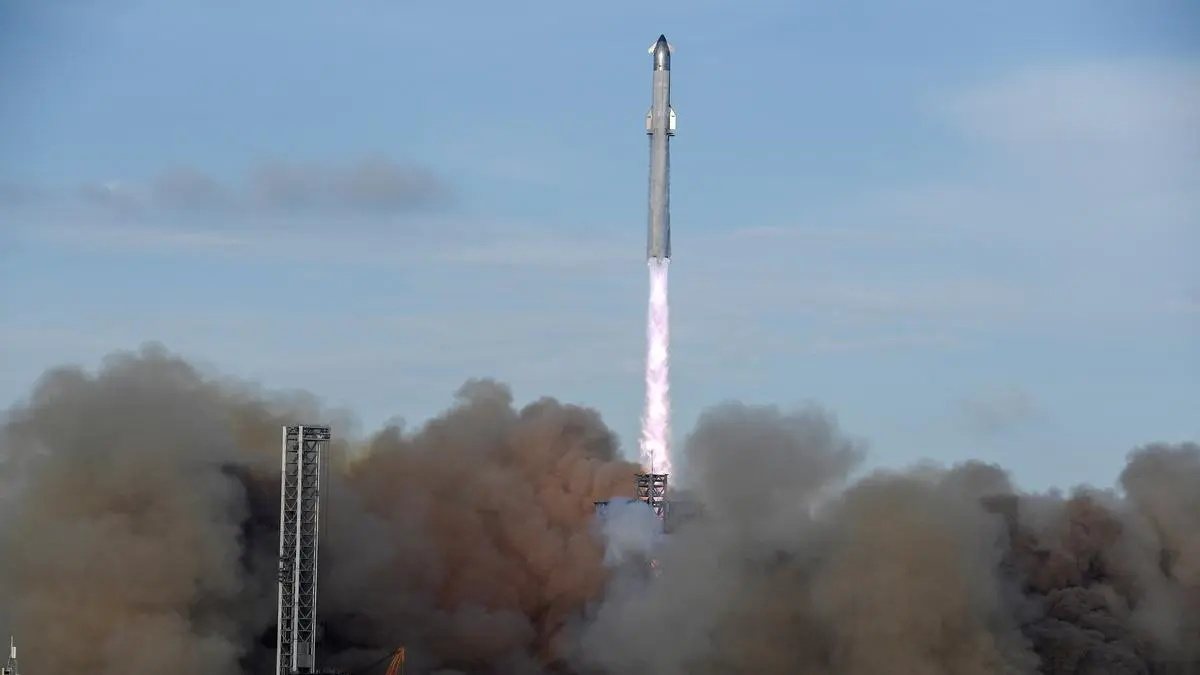
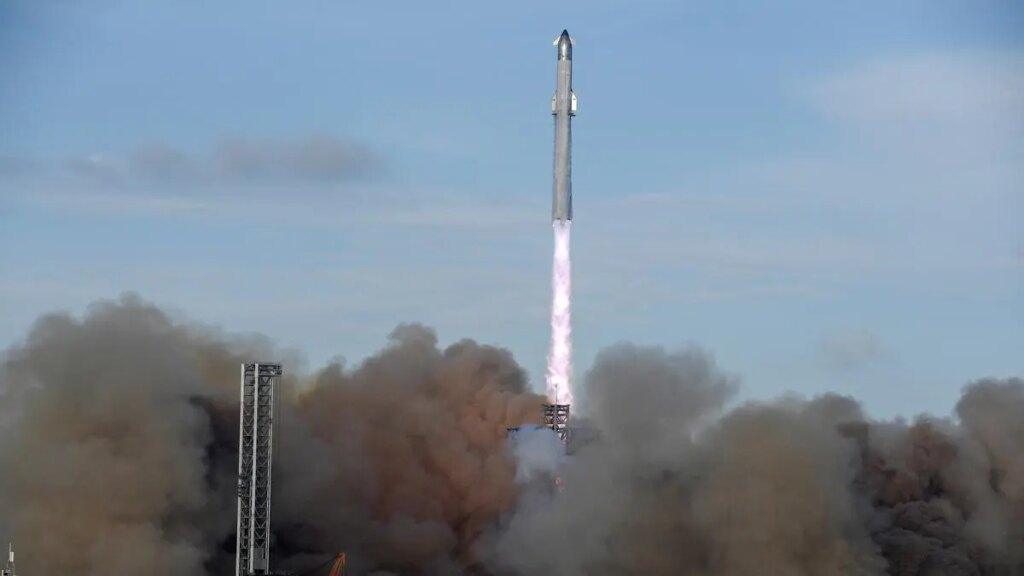
A SpaceX Super Heavy booster carrying the Starship spacecraft lifts off on its 10th test flight at the company’s launch pad in Starbase, Texas, US, August 26, 2025.
| Photo Credit:
STEVE NESIUS
SpaceX’s Starship rocket launched to space and deployed satellites for the first time before surviving most of its journey to Earth, achieving new technological milestones after a year of fiery setbacks.
The mission secured a much-needed win for the Elon Musk-led company after flight test struggles raised questions about whether Starship will be able to fulfill the billionaire’s aims.
Advertised as the largest and most powerful rocket ever built, Starship is the centrepiece of the company’s plans to loft huge batches of its Starlink internet satellites into Earth’s orbit and carry humans to the moon and, eventually, Mars.
The vehicle lifted off from SpaceX’s South Texas launch facility, called Starbase, at 6:30 p.m. local time on Tuesday. Its Super Heavy booster successfully separated from the Starship spacecraft as planned, and then splashed down in the Gulf of Mexico.
The Starship spacecraft then continued its journey through space and, about 20 minutes into the mission, began deploying a batch of dummy satellites that are similar in size and weight to the future Starlink satellites.
SpaceX employees watching the broadcast cheered as the satellites left the vehicle one by one — a closely watched milestone SpaceX failed to complete during its ninth test flight.
Applause erupted again inside mission control when the Starship spacecraft reentered Earth’s atmosphere and splashed down in the Indian Ocean about an hour later, before seemingly exploding after hitting the water.
Ultimately, the SpaceX team considered the flight to be mostly a success.
“Congratulations, all of our teammates here at SpaceX,” Dan Huot, a communications manager at SpaceX, said during the livestream when the mission had ended. “It’s been a year. Everybody that’s worked on this programme, this is what we’re working for.”
SpaceX has had a rough year of development, with its first two flights of 2025 blowing up within minutes, and a third failed to deploy dummy satellites and spun out of control. Another Starship spacecraft exploded on a test stand in June during fueling.
The company often says it uses failures as learning opportunities that it can apply to future launches. But after a lackluster start to the year, this week’s mission faced extra pressure to perform better than the others.
“There are thousands of engineering challenges that remain for both the ship and the booster,” Musk told viewers on Monday before a launch attempt that was delayed, noting that Starship’s heat shield was perhaps the biggest problem in need of solving.
Starship is designed to be fully reusable and is supposed to eventually replace SpaceX’s Falcon 9, becoming the company’s sole rocket for launching satellites and humans to space.
NASA has awarded SpaceX contracts worth roughly $4 billion to use Starship to shuttle astronauts to the lunar surface. The eventual goal is to land and take off from the moon and Mars.
But the company is still trying to demonstrate that the rocket can achieve orbit, deploy satellites and return to Earth fully intact.
During Tuesday’s mission, Starship relit one of its Raptor engines briefly as part of another in-flight test. The vehicle will need to restart its engines in order to maneuver in space and take itself out of orbit.
SpaceX has so far shown on two flights that it can catch the Super Heavy booster midair using giant mechanical arms. For Tuesday’s mission, SpaceX opted not to return the booster to the landing site, instead maneuvering the craft into a controlled landing off the US coast.
SpaceX also once again performed a number of experiments with Starship’s heat shield tiles, which cover the side of the vehicle and are meant to keep the spacecraft from overheating when it reenters the atmosphere.
The vehicle’s flaps still seemed to suffer damage, with pieces breaking away during the return trip to Earth.
More stories like this are available on bloomberg.com
Published on August 27, 2025
[ad_2]
Source link