[ad_1]

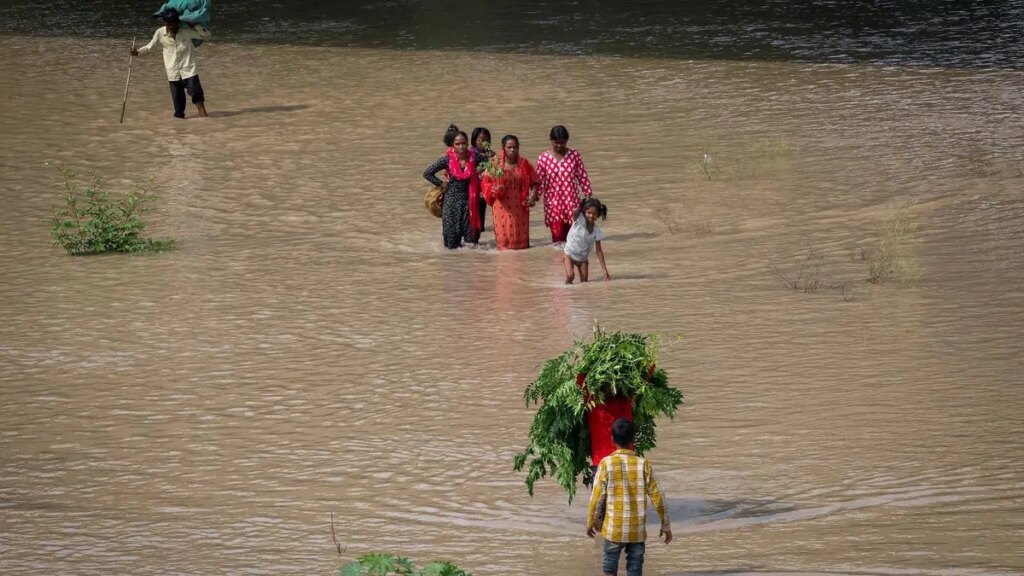
People wade through a flooded road after a rise in the water level of river Yamuna due to heavy monsoon rains, in New Delhi
Rain fury continued to lash north Indian States of Jammu and Kashmir, Himachal Pradesh, Punjab, Haryana, Rajasthan and Delhi, with most of the rivers flowing above danger marks. Apart from loss of human lives, roads and other infrastructure have been badly hit at many places. The expectation of a bumper agricultural output in view of higher acreage and overall good rainfall until mid-August, has dissipated after heavy rains and floods affected agricultural lands as well as horticulture production.
According to India Meteorological Department (IMD) data, the rainfall on Wednesday in Jammu and Kashmir was 1,289 per cent above normal while it was 821 per cent surplus in Haryana, 552 per cent surplus in Punjab, 423 per cent higher in Himachal Pradesh, 339 per cent more than normal in Delhi and 40 per cent above normal in Rajasthan.
On September 2, there was heavy rain in these States – Haryana 806 per cent, Punjab 759 per cent, Delhi 740 per cent, Himachal Pradesh 510 per cent, Jammu and Kashmir 278 per cent and Rajasthan 193 per cent higher than average.
The actual rainfall in these States (except Rajasthan) was 24-67 mm on September 3 and 17-46 mm on September 2.
“In the Indo-Gangetic plains, normally water logging does not happen. But the continuous heavy downpour is neither good for the field crops nor for horticulture. Some days of dry weather needed immediately, particularly in Punjab,” said agriculture scientist A K Singh.
The Central Water Commission has said that due to extreme flooding in few locations there may be temporary disturbances of data availability in few stations. The CWC dashboard is not displaying extreme flood events, which have affected normal life in Punjab and Himachal Pradesh. But it shows several rivers in Uttar Pradesh and Bihar are flowing much above normal levels, some even have crossed danger marks.
For instance, water level in Rambiara river in Pulwama district of J&K was at 1,595.22 meter at 7 pm Wednesday, surpassing its previous highest of 1,593.33 meter in 2022.
The Centre has set a target of 168.88 million tonnes (mt) of foodgrains production – rice 120.75 mt pulses 7.74 mt, nutri cereals (Shree Anna) 40.39 mt and maize 26 mt from Kharif 2025 season.
Former agriculture commissioner J S Sandhu said that as there were favourable monsoon rains in June and July, which is the prime period of sowing of Kharif crops, the acreage has not expanded much beyond the normal area of 1,097 lakh hectares (lh), though with variations for different crops.
“There is a need to look up how to make available barren land for cultivation in States such as Uttar Pradesh, Rajasthan, Madhya Pradesh and Maharashtra. The government must develop some plans for long term land reclamation,” Sandhu suggested.
rescue underway
Meanwhile, Union Agriculture Minister Shivraj Singh Chouhan has announced a visit to Amritsar, Gurudaspur, and Kapurthala districts of Punjab on September 4 to review the situation due to flood.
Army’s Western Command, after being pressed into conducting large-scale humanitarian assistance and relief operations in flood-affected areas of Jammu and Kashmir and Punjab, said in a statement that more than 5,500 civilians and 300 personnel of paramilitary forces have been rescued, so far. Also over 3,000 civilians have received medical aid, and over 27 tonnes of ration and essential supplies have been delivered to affected communities in which more than 50 Army columns on the ground are operating.
Published on September 3, 2025
[ad_2]
Source link