[ad_1]
Methods
Protocol and registration
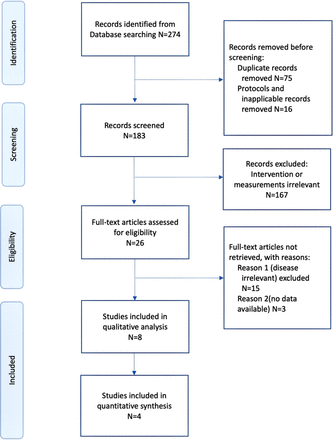
This systematic review conducted was designed and reported in accordance with the Preferred Reporting Items for Systematic Reviews and Meta-Analyses (PRISMA) 2020 statement31 and AMSTAR (Assessing the methodological quality of systematic reviews) 2 Guidelines.32 The protocol was registered on International Platform of Registered Systematic Review and Meta-analysis Protocols database (INPLASY Number: INPLASY202370080) and Research Registry (UIN: reviewregistry1706).33
Search strategy
We conducted a comprehensive search of electronic databases, including MEDLINE, EMBASE and the Cochrane Library, from their inception to May 2023. The search strategy involved using free text and search strings related to two groups of core concepts. The first group encompassed keywords related to bidirectional chatbots, such as ‘chatbot’, ‘conversational agent’ and ‘conversational system’. The second group included keywords related to the perioperative period, such as ‘surgery,’ ‘intervention,’ ‘preoperative,’ ‘postoperative,’ or ‘perioperative’. Keywords were organised using the following three approaches: (1) To search for all terms that begin with a keyword, the word is typed followed by an asterisk (*) (eg, surgery* for surgery and surgeries). (2) Keywords within one group are combined using the OR operator (eg, ‘chatbot’ OR ‘conversational agent’). (3) Keywords across different groups are linked using the AND operator (eg, ‘chatbot’ AND ‘perioperative’ AND ‘intervention’).
Inclusion and exclusion criteria
Three independent reviewers screened the titles and abstracts of identified articles and then assessed full-text articles for eligibility. To ensure the relevance and quality of the included studies, we applied the following inclusion criteria: (1) treatment focusing on invasive treatment, surgery or anaesthesia; (2) studies using any form of bidirectional chatbots (eg, messenger, short messaging service or websites); (3) studies reporting original data from randomised trials, clinical trials or observational studies; (4) studies reporting qualitative or quantitative results on interventions (chatbots); (5) English articles published from January 2019 to May 2023 and (6) interventions focusing on the perioperative period. Additionally, reviews and meta-analyses were screened for potentially eligible articles.
The exclusion criteria were as follows: (1) protocols rather than studies; (2) non-surgical and non-invasive treatment, such as physiological monitoring, chemical therapy, routine clinical procedures and treatment without a perioperative component; (3) studies that only focused on unidirectional short message service; (4) studies whose measures only focused on mental health, health behaviours or physiological data instead of perioperative care outcomes, or (5) non-English-language publications.
Participants
Eligible studies were those conducted on adult patients who had undergone or scheduled to undergo any surgical or invasive intervention; intervention in those studies are conversational agents (chatbots). Surgical interventions encompassed surgeries across various specialties, such as vascular surgery, urology, orthopaedics, anesthesiology and radiology. The selected eight articles were conducted in patients who underwent physical interventions such as ureteroscopy for kidney stones, primary total hip replacement for osteoarthritis, breast biopsy, hip arthroscopy for femoroacetabular impingement syndrome, anaesthesia before elective orthopaedic surgery and treatment for lower extremity superficial venous reflux disease.
Interventions and comparators
The intervention in this study involved the implementation of a chatbot applications for perioperative care. A chatbot was defined as a computer software application that permits two-way conversation (through text, speech or a combination of both) between a human user and a computer programme. No restrictions were placed on chatbot platforms or interfaces.
In three included comparative articles, comparators included routine procedures such as traditional preoperative assessment, consultation and postoperative follow-up delivered via face-to-face outpatient clinics by physicians.
Data extraction and conversion
Data from the selected studies were extracted using a standardised data extraction form.34 The following information was collected: study characteristics (eg, author, year of publication, country and study design), participant characteristics (eg, demographics, surgical procedure type and sample size), chatbot intervention features (eg, technology platform and intervention time point) and perioperative outcomes (eg, data on satisfaction, knowledge acquisition and adherence). These extracted data were collated, cross-checked by other authors, and compared.
In patients’ self-reports or questionnaires, a chatbot’s assistance that improved patients’ understanding of a procedure was defined as enhancing knowledge acquisition. For ease of comprehension and systematic representation, the authors converted the data on satisfaction and knowledge to a standardised Likert-5 scale ranging from 1 to 5. Additionally, data on the proportion of participants providing a rating of 4–5 were extracted for further analysis of untransformed proportions.
Statistical analysis
Quantifiable data were collected from patients’ self-reports or questionnaires. Meta-analysis of four and three articles was performed for assessing satisfaction and knowledge acquisition respectively. The meta-analysis was conducted using Review Manager V.5.4 (RevMan, V.5.4.1, the Cochrane Collaboration, 2020) and Open Meta-Analyst software.35 The effect size was calculated using untransformed proportions for proportional and continuous data with a 95% CI. The heterogeneity among studies was assessed and a random-effects model was used.
Publication bias
We did not evaluate publication bias using funnel plot or related tests, as the included studies fell short of the minimum of 10 required for such evaluation.36
Outcomes
The primary and secondary outcomes assessed were satisfaction (defined as the proportion of patients who indicate they are ‘satisfied’ or ‘very satisfied’) and knowledge acquisition (defined as the proportion of patients who indicated that they ‘agree’ or ‘very much agree’ with the assistance of a chatbot in education of perioperative information) after chatbots were used for perioperative communication. Untransformed proportional data on patients’ satisfaction and knowledge acquisition in the four relevant studies were subjected to a meta-analysis. A forest plot was generated using Open Meta-Analyst software. The forest plot displayed the effect sizes and CIs of each included study as well as the overall pooled effect estimates. Other outcome measures reported by studies included patient adherence, patients’ chatbot usage, patient feedback, postoperative opiate usage, and technical details related to chatbot performance.
Quality assessment
The Methodological Index for Non-Randomised Studies (MINORS)37 and a Cochrane risk-of-bias tool (RoB 2)38 were used by three independent reviewers to evaluate the methodological quality of studies.
The included comparative and non-comparative studies were subjected to qualitative analysis by using the revised MINORS. Two included randomised controlled trials (RCTs) were additionally assessed using RoB 2. Disagreement in ratings were resolved through the involvement of a third party or mediator.
[ad_2]
Source link