[ad_1]
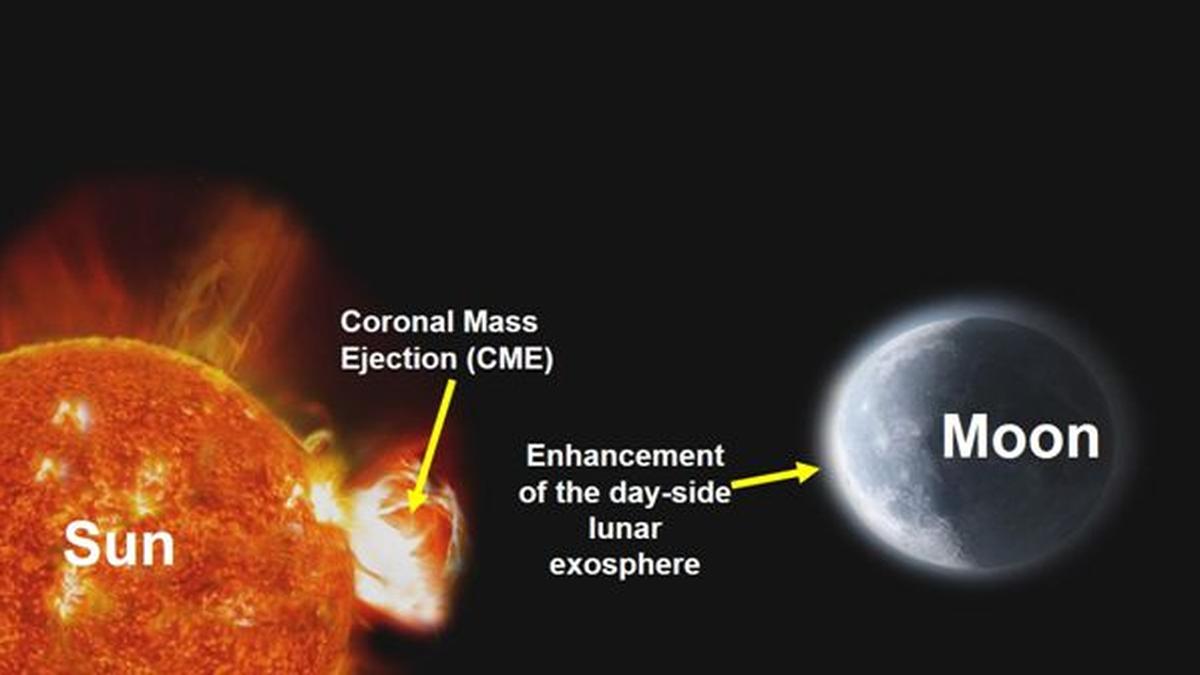
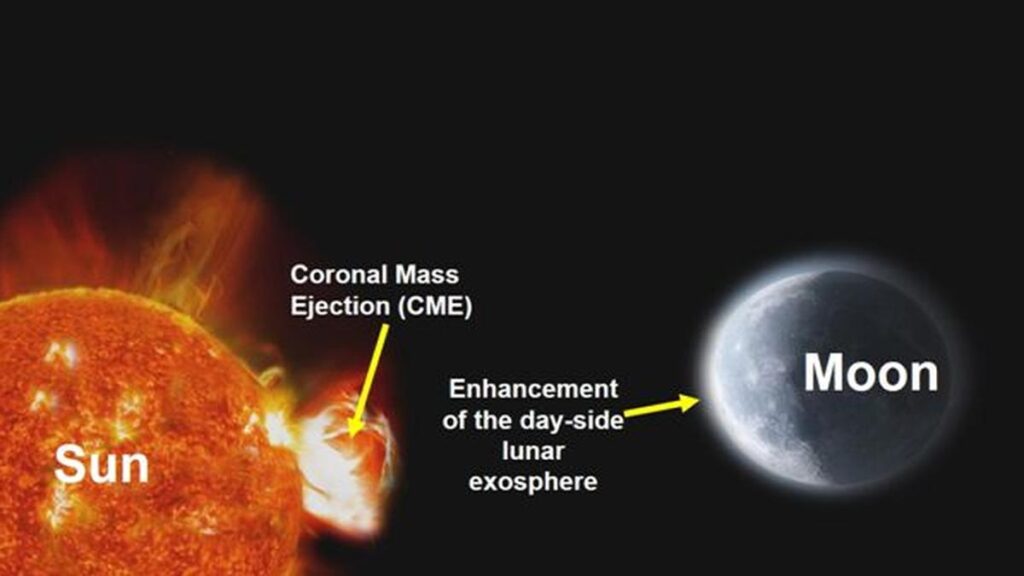
Artistic rendition of the CME hurled by the Sun towards the Moon, and its effect on the day-side lunar exosphere (for visualisation only; not up to the scale). Photo: isro.gov.in
The lunar orbiter of India’s second moon mission Chandrayaan-2, launched in 2019, has made the first-ever observation of the effects of the Sun’s Coronal Mass Ejection (CME) on the Moon.
The Chandra’s Atmospheric Composition Explorer-2 (CHACE-2) payload onboard the orbiter has made this observation.
The Indian Space Research Organisation (ISRO) said on Saturday (October 18, 2025) that the observations from CHACE-2 showed an increase in the total pressure of the dayside lunar exosphere (very thin atmosphere) when the CME impacted the Moon.

“The total number density (number of neutral atoms or molecules present in an environment per unit volume) derived from these observations showed an increase by more than an order of magnitude. This increase is consistent with earlier theoretical models, which predicted such an effect, but CHACE-2 onboard Chandrayaan-2 has observed such an effect for the first time,” ISRO said.
ISRO added that the opportunity to directly observe the effects of the CME impacting on the Moon came in a rare occurrence, on May 10, 2024, when a series of CMEs were hurled by the Sun.
“This increased quantity of the solar coronal mass that impacted on the moon enhanced the process of knocking off the atoms from the lunar surface, thereby liberating them to the lunar exosphere, which manifested as the enhancement of the total pressure in the sunlit lunar exosphere,” ISRO added.
The space agency said that this observation would provide scientific insight in the understanding of the lunar exosphere and space weather effects on the Moon. “Apart from pushing the edge of our scientific understanding about the Moon and the lunar space weather (effect of the Sun’s emissions on the Moon), this observation also indicates the challenges of building scientific bases on the Moon. Lunar base architects need to account for such extreme events, which would temporarily alter the lunar environment, before the effects subside,” it said.
Launched on July 22, 2019, from Sriharikota using the GSLV-MkIII-M1 rocket, Chandrayaan-2 carried eight experiment payloads. On August 20, 2019, Chandrayaan-2 was successfully inserted into the elliptical orbit around the Moon.
However, the Vikram lander, while attempting to make a soft landing on the Moon’s surface, lost communication from the lander and the ground stations.
Published – October 19, 2025 06:27 am IST
[ad_2]
Source link