[ad_1]
AAIB Preliminary Report: In the wee hours of Saturday, July 12, the Aircraft Accident Investigation Bureau (AAIB) quietly released its preliminary findings into the tragic crash of Air India Flight AI-171 in Ahmedabad.
While the 15-page document met the 30-day international reporting mandate, it did little to assuage growing unease within aviation circles.
The fatal June 12 crash of the Boeing 787-8 Dreamliner killed all 241 passengers and crew on board, along with 19 people on the ground, causing a total of 260 casualties. Contrary to earlier reports suggesting that the flight data and cockpit voice recorders (CVR) had been sent overseas for analysis, investigators confirmed that the black box data was currently being examined in New Delhi.
AAIB preliminary report findings
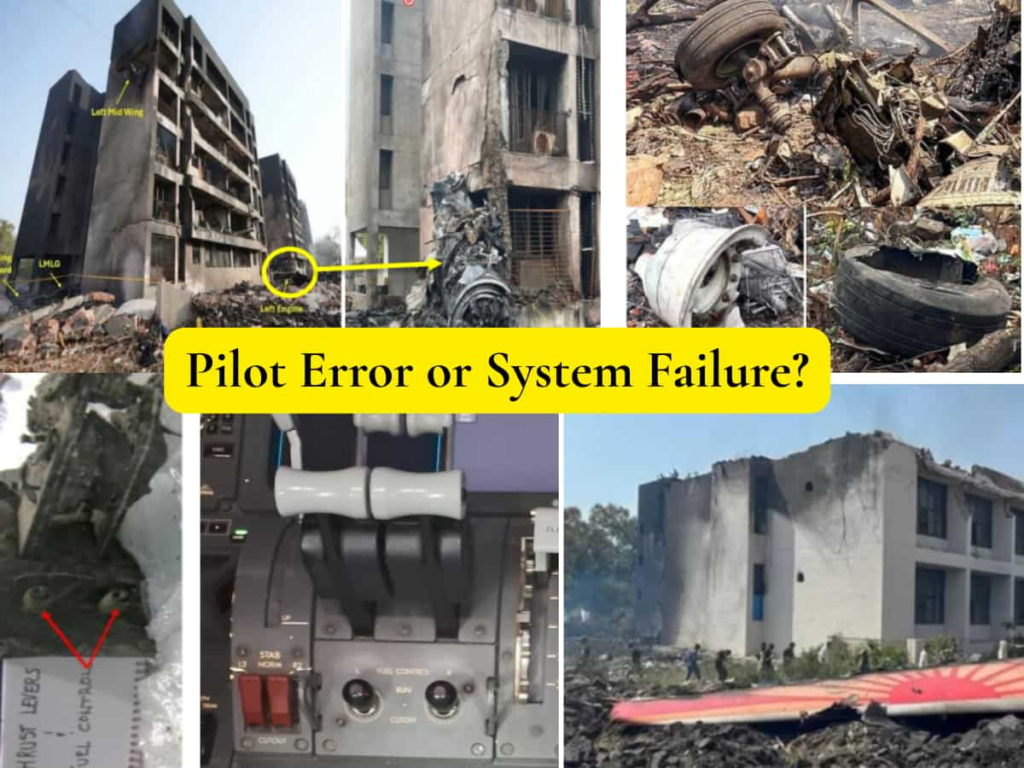
The AAIB’s findings revealed that both engine fuel control switches moved from the ‘RUN’ to the ‘CUTOFF’ position within a second of each other, just moments after takeoff. The result was a catastrophic dual engine shutdown. Although an automatic engine relight was initiated, it proved too late to avert disaster.
At the centre of the report lay a chilling fragment of cockpit voice recording. One pilot was heard asking: “Why did you cut the fuel?” To which the other responded: “I didn’t.”
The report neither identified the speakers nor offered further context, leaving room for widespread speculation. However, aviation experts urged caution, warning against drawing conclusions from an isolated exchange, especially without the complete CVR transcript or flight data analysis.
FAA Advisory Ignored: A warning that went unheeded?
One of the key revelations in the preliminary report was the reference to a 2018 FAA Special Airworthiness Information Bulletin (SAIB)—No. NM-18-33—issued on December 17, 2018. This bulletin flagged concerns regarding the locking mechanism of engine fuel control switches across several Boeing aircraft.
The SAIB noted that some operators had reported that the fuel switches could be moved without lifting them—suggesting a degradation in the locking feature. While the FAA concluded the issue was “not an unsafe condition” requiring a formal Airworthiness Directive (AD), it nonetheless advised airlines to carry out checks.
The switches in question—part number 4TL837-3D—were also installed on the B787-8 aircraft model, including the ill-fated VT-ANB operated by Air India.
According to the AAIB, Air India did not carry out the recommended inspections, citing the advisory nature of the SAIB. Maintenance records showed that the throttle control module was replaced on VT-ANB in 2019 and 2023, though neither change was linked to the fuel control switch mechanism. The report also confirmed that no defects related to the fuel control switch had been reported on the aircraft since 2023.
FAA’s Ignored Advisory: Non-mandatory, yet critical?
Veteran IAF pilot Captain Ehsan Khalid believed the airline could not be faulted. “FAA Advisory of 2018 was not followed up by Boeing, GE, or Honeywell for seven years. No maintenance practices were issued to make this switch safer. As far as Boeing and GE are concerned, the fuel switches were already as safe as they could be,” he told Zeebiz.com
Differing Views: Preventive action could have been taken
But others disagreed. Aviation expert Vipul Saxena pointed out that the switch design was nearly identical across Boeing aircraft and said that should have been enough for Air India to take preventive steps. “Since the switch design is common across Boeing aircraft, Air India should have done at least some checks to rule out possible failure.”
Aviation expert Sanjay Lazar noted that the advisory may not have been mandatory but was certainly not meaningless. “If the switch can be moved without lifting, it means that the locking feature is disengaged and needs immediate replacement.”
Lazar also cited a May 2, 2022, FAA Requirements Bulletin issued after a Boeing advisory which warned of Foreign Object Damage (FOD) risks. According to the FAA, FOD could lead to uncommanded engine fuel shutoff or failure of fire handles, posing serious safety hazards.
He further recalled a 2013 ANA incident in Japan, where a Dreamliner experienced a ground power loss due to a fuel shut-off, later traced to a faulty engine sensor: “The ANA 787 lost power on the ground due to fuel shut-off, on January 16, 2013, at Takamatsu Airport in Japan. The investigation found a faulty engine control sensor as the root cause.”
Was It a Pilot error or system malfunction? ‘Too Early to Conclude’
Amid growing speculation, the Aircraft Accident Investigation Bureau (AAIB) report stopped short of assigning blame. However, a single line quoted from the cockpit voice recorder without any context sparked debates around pilot error. Aviation experts cautioned against jumping to conclusions.
“Quoting a conversation without context or time can give misleading conclusions,” said Khalid. Lazar echoed the same concern: “They have just pulled out one sentence from the CVR and not shared its data, when they should have shared the entire readout. Sadly that single sentence has led to a lot of speculation.”
On the other hand, Saxena offered technical reading of the incident. In his view, the switches were operated in response to an electrical malfunction, not mistakenly by the crew.
“It looks like fuel starvation triggered by an electrical malfunction. The pilot likely believed the other had shut off the fuel. When denied, he instinctively recycled the switch to reignite. It was the correct response, but there just wasn’t enough time.”
He added that while the switches themselves were mechanical and required deliberate action, the systems beneath them could have failed. “These are mechanical switches with locks; they don’t move on their own. But the electrical systems underneath could malfunction and trigger a warning light.”
No space for pilots to defend themselves?
All three experts raised concerns over transparency, especially given the timing and structure of the preliminary report, which was quietly published at night and lacked a date or signature.
“Dead pilots don’t have trillions of dollars at stake. If they were guilty, the full CVR transcript and FDR data would’ve been splashed across media with a press conference,” said Khalid. “Dead pilots have no influence to get preliminary report released in dead of the night and that too a report which is not dated and not signed,” he added.
Saxena questioned the depth of the investigation. “Only the nose EFR (Engine Fuel Recorder) was reviewed. The tail EFR wasn’t. We don’t know which pilot said what. The report lacks clarity.”
Rising speculation over transparency
There was also disagreement on how transparent such investigations should be. Khalid supported involving pilot associations like ALPA-India in the process. “Yes. Pilots should be represented in the larger interest of Flight Safety.”
Saxena, however, argued for a more cautious approach. “Investigations shouldn’t be public, but conclusions must be backed by evidence—which this report lacks.”
With the final AAIB report expected in a year, experts agreed on one thing: rushing to conclusions risks doing more harm than good. “It’s premature to blame anyone. Yet this report leans toward blaming the pilots and letting Boeing and GE off the hook—without sufficient proof,” Saxena said.
[ad_2]
Source link