[ad_1]
Abstract
Objectives Since the COVID-19 pandemic started, an increasing number of individuals use online resources to obtain health-related information, including myopia management. We aimed to obtain the search interest of global public health on myopia and prevention/treatment methods before and after the outbreak of COVID-19.
Methods Google Trends was used to assess the global search interest in myopia and related terms. Data spanning from 2019 to 2023 were collected and segmented into three periods: prepandemic (2019), pandemic year (2020) and postpandemic (2021–2023). Each average search volume index was used to examine public awareness with the Kruskal-Wallis test.
Results Among commonly used search keywords, Myopia is preferred over more colloquial terms (Nearsighted and Shortsighted). During the pandemic, searches for Myopia remained stable, while postpandemic, interest in Myopia surged (31.54%, p<0.0001). Myopia prevention/treatment awareness from 2019 to 2023 indicated notable shifts. In 2020, searches for Contact lenses and Spectacles decreased (−14.09% and −21.97%, respectively, both p<0.0001). These trends persisted postpandemic, with declining searches for Orthokeratology (−41.38%, p<0.01). Public interest for Light therapy (43.00%, p<0.0001) and Atropine (27.42%, p<0.0001) increased.
Discussion The research highlights significant increases in global online awareness of myopia during the COVID-19 pandemic. The extended period of remote work during the pandemic may alter lifestyle habits and affect public perception of treatment options. Those findings could offer valuable perspectives on global interest patterns related to myopia, which supports subsequent myopia studies and is further useful to develop relevant public health policies.
Introduction
Myopia, commonly known as nearsightedness or shortsightedness, is a common vision condition in which near objects are clearly seen; however, far objects look unclear. Myopia incidence has significantly increased over the recent decades, currently affecting approximately 30% of people worldwide.1 The COVID-19 pandemic worsened myopia prevention and management, straining healthcare systems and disrupting regular eye care due to lockdowns.2 The shift to online learning and reductions in outdoor activities during the pandemic have also contributed to a potential increase in myopia cases.3 In response to those concerns, digital strategies have become one of the key resources for getting information on eye health.4 Google Trends analysis has been recently used to assess public awareness of various diseases and interventions and to analyse alterations in trends over time and regions.5 In our study, we describe online global awareness of myopia and related prevention/treatment during the COVID-19 pandemic and examined trends of public attention.
Methods
We queried the Google Trends database to assess the global search interest for myopia and relevant terms. Google Trends provides largely unfiltered samples of real search queries made on Google. Specifically, it algorithmically normalises search results to the time and location of the queries. Google Trends reports Search Volume Index (SVI) as a parameter showing search popularity. The SVI range of any term is from 0 to 100, where 0 means the lowest public attention, 100 means the highest, and the smallest unit of change is 1.
Myopia, Nearsighted and Shortsighted were selected as general searching terms for myopia. We also selected common myopia prevention and treatment methods in recent years as further keywords: Orthokeratology, Contact lenses, Spectacles, Light therapy and Atropine. Data were divided into three well-known periods: before the pandemic (2019), the year of the pandemic (2020) and the postpandemic (2021–2023).
Statistical analyses were performed using Prism, V.9.5 (GraphPad Software). The Kruskal-Wallis test was performed to compare SVIs between the different periods, followed by Dunn’s posthoc test (p value <0.05, statistically significant).
Results
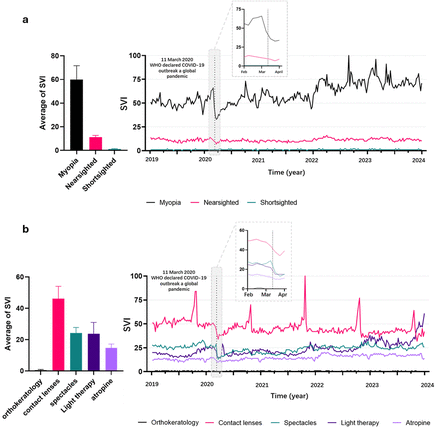
The SVI for general myopia-related terms from 2019 to 2023 is depicted in figure 1a. Myopia emerges as the most queried term, showing a global decline in search interest in March 2020, which coincides with the WHO’s declaration on global pandemic COVID-19. In-depth analyses of SVI averages across the years exhibited no significant changes in Myopia between 2019 and 2020 (online supplemental table S1). Interest in Myopia surged by 31.54% (p<0.0001) postpandemic, aligning with increased myopia cases reported following the pandemic.3 The geographical distribution of this data is illustrated in online supplemental figure S1.
Time-based changes in awareness of myopia-related terms before and after the pandemic. (a) Average of SVI for Myopia, Nearsighted and Shortsighted from 2019 to 2023. A bar represents mean±SD; trends in SVI change over time for myopia-related terms from 2019 to 2023. (b) Average of SVI for Orthokeratology, Contact lenses, Spectacles, Light therapy and Atropine from 2019 to 2023. A bar represents mean±SD; trends in SVI change over time for myopia-related terms from 2019 to 2023. SVI, Search Volume Index.
Figure 1b illustrates SVI trends for terms of myopia prevention and treatment from 2019 to 2023. Notably, a significant decrease in search interest was observed in Contact lenses (−14.09%, p<0.0001) and Spectacles (−21.97%, p<0.0001) in 2020 (online supplemental table S1). Postpandemic, three terms showed declining shifts: Orthokeratology (−41.38%, p<0.01), Contact lenses (−17.30%, p<0.0001) and Spectacles (−9.25%, p<0.0001). Light Therapy and Atropine demonstrated significant increases (43.00% and 27.42%, respectively, both p<0.0001).
Discussion
This study indicates that the COVID-19 pandemic did not reduce online engagement with myopia; in fact, global online interest in myopia showed a significant increase following the pandemic. While online public interest in various non-COVID chronic disease conditions declined during the COVID-19 pandemic, myopia showed the opposite trend.6 The pandemic increased close-range activities and reduced outdoor time, both risk factors for myopia. This implies that a distinct system might be needed for myopia prevention and control.
Moreover, our findings demonstrate a change in public interest in myopia prevention/treatment options in 2020, likely linked to lack of outdoor activities and challenges in accessing eye care services.7 Interestingly, even after the pandemic, public interest in orthokeratology, contact lenses and spectacles continued to decline. The extended remote work during the pandemic may change lifestyles and public perception of treatment options. Conversely, interest in light therapy and atropine has increased. Recent advances in light therapy through preclinical/clinical studies have gained public attention, offering new insights for myopia management.8 Atropine eye drops is a well-known method for controlling myopia.
This observation could shape future research and policies in myopia management, reflecting a global shift in patient interests and information-seeking behaviour. Intriguingly, the research volume of Myopia increased in both the USA and Japan from 2019 to 2023, with a relatively greater rise observed in Japan (online supplemental figure S2). Future analyses of regional differences may provide further insights into global myopia awareness and concerns. Limitations include that Google Trends may not fully capture search activities in multilingual contexts and may lack reliable data from regions with minimal search traffic.5
[ad_2]
Source link