[ad_1]
What if Rajkumar Hirani made Ritesh Batra’s Photograph? The result would likely resemble Vasanth’s Rhythm, a film coded in Batra’s low-key emotionality yet steeped in the Hirani school of heightened drama.
Released just months after Alaipayuthey and Kandukondein Kandukondein, Rhythm, which turns 25 this year, belongs to the kind of films one longs for when reflecting on the state of contemporary adult romances. At a time when star vehicles leaned on shallow commercial formulas, these films stood out for their humanism and mature approach to romance, rarely infringing upon a character’s agency for the sake of plot. There was a tenderness in the way the romantic encounters were written, conceived, and staged in these films. The implied sexism in usual mainstream films was foregone for respectful representations of men and women falling in love in these films.

Vasanth builds the world of Rhythm without grand declarations, swooning gestures, or overt melodrama. Instead, it finds poetry in the ordinary: two strangers in Mumbai crossing paths on their daily commute. The film inverts the high-energy character types typical of the sub-genre, centering its story on two socially awkward loners who rarely meet each other’s gaze and mostly mind their own business.
There is no trace of ogling or perverse stalking in the way Karthikeyan (Arjun Sarja) runs unknowingly into an unsuspecting Chitra (Meena); they just happen to be sharing the same commute with little to no acknowledgement of each other’s existence in the world. Both seem united only by their busy Mumbai existence, away from their homeland, Chennai. The film tactfully throws in the ‘immigrants isolated in the big city’ motif through the way they first exchange words and register in each other’s eyes. Weirdly enough, a throwaway, harmless joke about Tamil people breaks the ice (or it seems), and without exchanging a word, Chitra, a bank employee, takes notice of the new customer who has moved from Chennai to Mumbai to pursue a career in photojournalism. They meet daily. Karthikeyan tries to break the ice even further, but something feels off in the way Chitra consistently turns down his attempts at casual friendship. Karthikeyan overstates their brief acquaintance, while she undersells it for obvious reasons. She seems withdrawn and strangely not comfortable opening up. These awkward, casual run-ins go on for a while as Karthikeyan gently moves on with his life, until a random theft brings them together again, only to become friends this time.
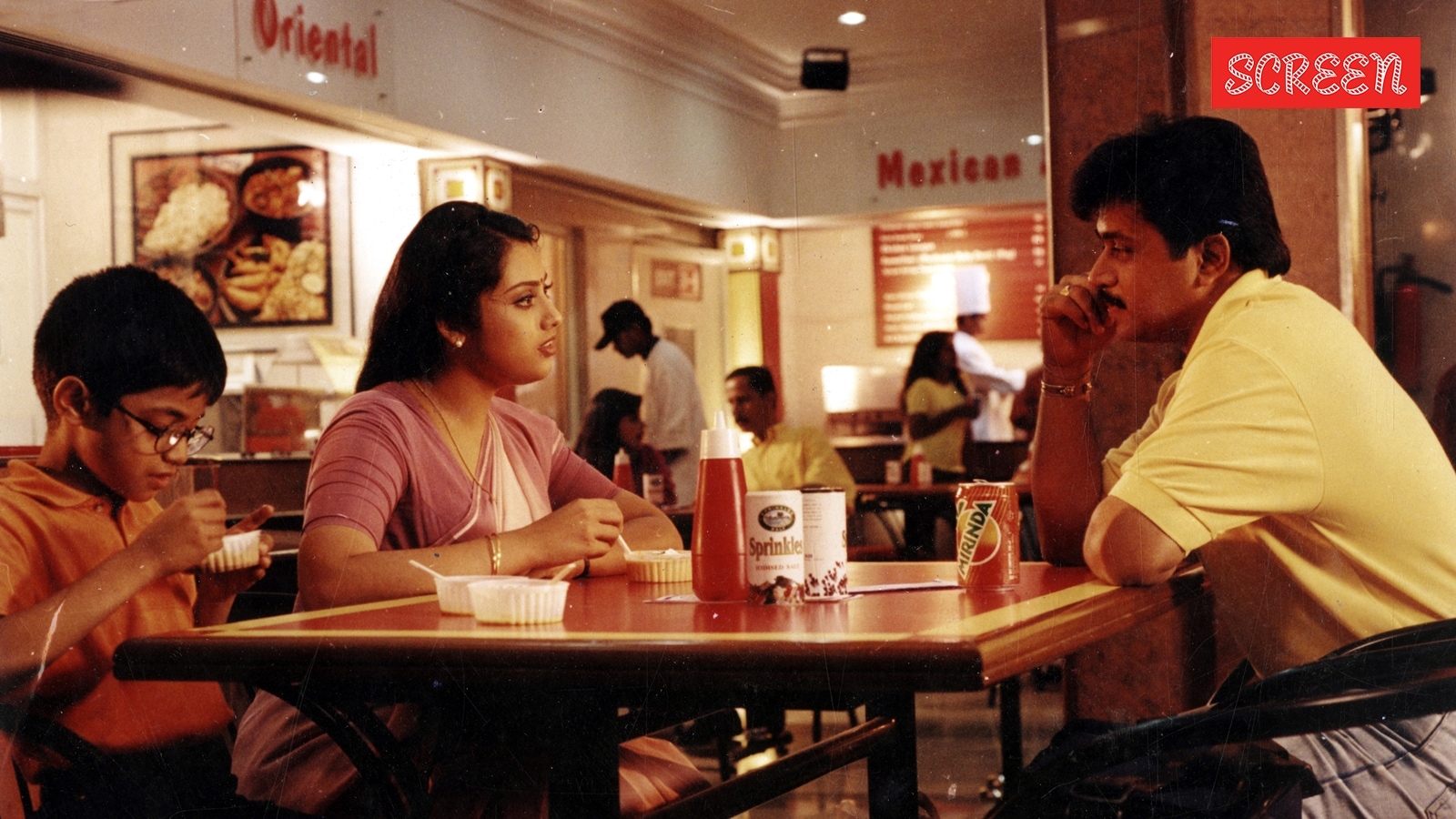 Arjun Sarja and Meena in the film Rhythm. (Express archive photo)
They start running into each other more often, exchanging bits about season local train tickets, shared autos, and you get a sense of Chitra finally giving in to the good-natured fellow passenger, who takes a similar interest in her peculiar, introverted ways. They bond over a stolen bag, an encounter with a sleazy cop, and an auto ride home. Director Vasanth builds these moments with much grace, and you get why these people behave a certain way, and this painstaking buildup to their friendship tells us who these people are without being judgmental of either of them for trying to make some sort of connection in a big city, full of strangers. As Karthikeyan’s parents move into the city with him and are introduced to his new friend in the city, they obviously form the wrong conclusions. But, on their insistence, when Chitra asks Karthikeyan about his decision to remain single in life, we are given a flashback into his first marriage. We get a tragedy that took away his first wife, and Chitra gets to learn more about Karthikeyan. Vasanth trips us with this brief revelation, only to follow up with a mirroring revelation about Chitra that upends the casual meetup between two strangers into the realm of ‘fate’, a major theme of the movie. The film then becomes a sophisticated yet poignant thesis on grief, tragedy, and the interconnectedness of faith.
Also Read | Before Madharaasi, examining the social issue based commercial cinema of AR Murugadoss
Story continues below this ad
Rhythm is not invested in the emotional inner lives or delving deep into the psychology of these characters. The restraint it shows in its emotionality is set off to an extent by the broad writing, which encapsulates a series of convenient occurrences that bring these two people into each other’s lives. There is no time spent in understanding the cumulative psychological impact of their first marriages and how their past trauma has informed who these two people are. But the odd pair of performers in Arjun Sarja and Meena makes this dissonance in the writing work. Their oddball matching makes perfect sense, as there is a contrast in their energies as performers that imbue even the generic moments with much life. There is a awkward energy in the way, Arjun Sarja, known for his larger than life ‘action king’ title, was chosen to play the soft spoken, tender Karthikeyan, and have Meena, an actress previously misused as a eye candy in superstar vehicles, be used as cocooned survivor of trauma, who is still feeling around to see whom she can trust in the world. To this already complicated scenario, Vasanth throws in a young (adopted) son of Chitra, from her previous husband’s past. There is so much potential to mess things up and be judgmental, and Vasanth rarely trips up in the minefield of his creation and finds graceful notes for his characters in between all the emotional distress.
Meena’s performance is especially noteworthy as she has to balance between a laconic indifference and a tender heart. The actress makes it impossible to look away from the screen. Her silences, glares, and empty nods speak volumes about a young woman who was left to fend for herself in the big city with a son and a hidden away grief weighing her down. She does not overdo the trauma part and is comfortable being quiet in scenes and letting her eyes do the talking. She guides you through Chitra’s arc with an air of assured distance in her emotional register. She has rarely been given such opportunities to dissolve into the background of a film, while simultaneously also being allowed to foreground her presence and gravitas to make a cipher-like character work on its own terms, without much overemphasis. Few films in her filmography reflect the sort of quiet range she gets to demonstrate here. She has obviously played more pronounced ‘survivors’ in Malayalam films like Olympian Anthony Adam (1999), Varnapakittu (1997), and the brooding, vengeful variety in films like Friends (1999). But there is a heightened superficiality in the ways these performances are pitched, and the actress is limited to caricaturist demonstrations of her inner life in these films, which are more out there and louder compared to Rhythm. In Rhythm, she is given the launchpad to hold herself back and suggest the emotional turmoil of the character as opposed to pronouncing it with eccentric theatricality like some of these other performances. Rhythm stands out in her filmography for this reason, as it lets her be and navigate scenes without the affectations of commercial cinema.
Arjun Sarja, too, is special in Rhythm. His rugged unfamiliarity with the genre lends a surprising tenderness to his portrayal of a man torn between the memory of his doting wife from the past and the woman he has fallen for in the present. The dichotomy in his character comes across in Arjun’s straight-faced rendition of lines that feel as though they’re being wrung out of him by circumstances.
Story continues below this ad
Four years before this film, in 1996, Cameron Crowe was making Jerry Maguire, a tale of a hyper-motivated, young sports agent finding his love in the single mother of a six-year-old boy. Vasanth does something similar in the way his film confronts society’s stigma against single mothers and their chances at love. Vasanth is not judgmental of Chitra at any turn, and understands the societal intricacies of such a plotline in a film made at the turn of the millennium, when globalization and import of western constructs of relationships had made its way into the country, but progressive ideals were yet a rarity in our cinema. The reaction of the parents to their son longing for a single mother, the grace with which Karthikeyan accepts her initial rejection, and the intimacy in the father stepping into the void of a child raised by a working mom, are all done with the necessary warmth and affection that you can’t help but root for these two characters to unite.
Rhythm even uses a sexual assault angle as a plot device that is a tad too digressive and tasteless for a film of such tender textures. But thankfully, the point being made trumps the haphazard execution by highlighting the agency of Chitra to an extent by not making her the damsel in distress who runs to Karthikeyan for saving. She, true to her character, prompted by a visitor from her past, makes a different choice that she, as a person, would make anyway, even if not for Karthikeyan.
Things are neatly wrapped up in an emotionally resonant climax, where Vasanth plays with our notions of these characters for just enough drama. The son finding a father figure, Chitra finding a companion and Karthikeyan finding a balm for his Rhythm is mostly remembered today for AR Rahman’s blistering album of chartbusters featuring ‘5 songs based on 5 elements of nature’ more than anything else. An entire article can be dedicated to the film’s spectacularly timeless album alone, but that’s for another day. Rhythm is the kind of film they say we don’t make anymore. A mature, sensitive love story about adults finding each other. Many films chase posterity, yet vanish within a few fleeting weeks. This one, however, deepens in resonance with every passing year.
[ad_2]
Source link