[ad_1]
Abstract
Objectives Barcode medication administration (BCMA) systems may improve patient safety with successful integration and use. This study aimed to explore the barriers and enablers for the successful use of a BCMA system by examining the patterns of medication and patient scanning over time and potential safety implications.
Methods Retrospective longitudinal study informed by prospective clinical observations using data extracted from five hospital wards over the first 16 months after implementation to determine trends in medication and patient scanning rates, reasons for non-compliance and scanning mismatch alerts. Regression models were applied to explore factors influencing medication scanning rates across wards of different specialties.
Results Electronic data on 613 868 medication administrations showed overall medication scanning rates per ward ranged from 5.6% to 67% and patient scanning rates from 4.6% to 89%. Reported reasons for not scanning medications were ‘barcode not readable’ and ‘unavailability of scanners’. Scanning rates declined over time and the pattern of reason codes for not scanning also changed. Factors associated with higher scanning rates included a locally led quality improvement (QI) initiative, the medication administration time and the medication formulation, for example, tablets and liquids. Overall, 37% of scanning alerts resulted in a change in user action. Staff tried to comply with the BCMA system workflow, but workarounds were observed.
Discussion Compliance with BCMA systems varied across wards and changed over time. QI initiatives hold promise to ensure sustained use of BCMA systems.
Conclusions BCMA systems may help to improve medication safety, but further research is needed to confirm sustained safety benefits.
Introduction
Medication administration errors are the most common adverse events in healthcare. An estimated 237 million medication errors occur every year in the National Health Service (NHS) in England, of which 66 million are clinically significant, with an increased risk of patient harm including adverse drug-related hospital admissions,1 2 approximately 700 deaths per year due to avoidable medication errors, and have an estimated annual financial cost of £98.5 million.3
Digital maturity within the healthcare setting is seen as essential for increased quality and safety as it supports the efficient and reliable flow of data between systems and makes data readily available for tracking patient outcomes, including those related to safety.4 Digital maturity is commonly taken to mean the implementation and use of sophisticated digital systems, typically including the integration of barcode medication administration (BCMA) systems, normally in conjunction with computerised physician order entry, electronic medication administration records, decision support systems and all patient records managed digitally.5 While many NHS trusts aspire to a high level of digital maturity, in practice it is difficult to achieve because alongside technology implementation, it also requires changes in working practices and upskilling staff to realise the benefits of greater digitisation.6
BCMA systems are designed to ensure the ‘five rights’ (right patient, medicine, dose, time and route) of medication administration and are frequently implemented in hospitals to improve patient safety outcomes.7 8 They can improve the safety of medication administration if used correctly, reducing the severity and frequency of medication errors and thus preventing patient harm.9 10 However, BCMA system use in practice often deviates from the designed workflow, which may be more linear than in practice. Workarounds, such as failing to scan either the patient or the medication, are routinely employed, resulting in working practices that bypass the safety features of BCMA systems.11–13 Factors contributing to poor BCMA system adoption include mismatched design with workflow,13 low nurse-to-patient ratio,14 organisational issues, such as deviation from medication administration policies or guidelines,15 issues with technology, such as malfunctioning hardware and software,16 and poor implementation strategies, such as lack of staff training, onsite support or poor communication.10 While no prior studies have explicitly compared BCMA practices internationally, a 1995 study comparing medication errors across US and UK hospitals17 found more errors—many due to failure to order required medications rather than failures in administration—in the US hospital. A more recent study comparing medication administration errors and workarounds using smart infusion devices18 found that joint commission guidelines on medication administration19 meant that practices in the USA are better defined and more standardised, resulting in the same practices being considered errors in the USA but workarounds in the UK. That study concluded that variations in practices across (and even within) hospitals were as great as variations between countries.
Adopting BCMA systems in the clinical setting can be complex. Patient and medication scanning compliance may change over time after the initial implementation drive. Many hospitals are therefore developing strategies to increase compliance with BCMA systems. Strategies, such as quality improvement (QI) initiatives20 and sustained engagement with system users,21 may be effective in increasing compliance with BCMA systems, although the long-term effect of these initiatives is less clear.22 There are few data-based studies of BCMA implementation and adoption in the NHS.
This study aimed to assess patient and medication scanning compliance following implementation of a BCMA system in an NHS hospital and understand the barriers and enablers and the potential impact on medication safety. This study also aimed to track how different clinical settings used the technology and any changes since implementation.
Results
A total of 613 868 medication administrations were analysed between April 2019 and July 2020. Wide variation was noted in both the average number of daily medication administrations (70.2 (ward W2) to 503.2 (ward A1)) and the average number of patients receiving at least one medication daily (11.4 (ward W2) to 53.9 (ward A1) (table 2)).
Medication and patient scanning compliance across five wards and reasons for non-compliance from April 2019 to July 2020
BCMA system scanning compliance
Overall compliance with medication and patient identification scanning varied across the five wards (table 2), ranging from 5.6% of medications and 4.6% of patients (ward A1) to 67% and 89%, respectively (ward W2). Patient barcode scanning was consistently higher than medication barcode scanning across all wards, except ward A1. Ward A1 had the highest volume of medication administrations and the lowest percentage of medication barcode scans (5.6% of 246 087 (approximately 13 380) administered medications). In ward W2, 67% of 34 909 (approximately 23 389) medication administrations were scanned compared with the busier ward W4, where 45% of 121 067 (approximately 54 480) medications were scanned. Despite wards N1 and N5 having similar mean numbers of daily medication administrations, the medication scanning compliance varied from 7% in ward N5 to 44.2% in ward N1. The main reason selected for not scanning a medication was ‘barcode unreadable’ across four wards (N1, N5, W2 and W4), ranging from 44% to 75%, and in ward A1, it was ‘scanner not available’ for 62% of the time.
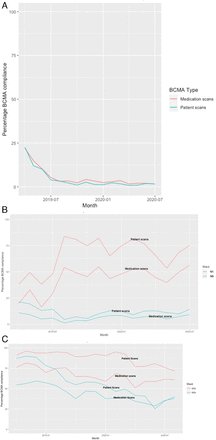
Monthly variations in medication and patient scanning compliance were evident within and across the study wards (figure 1A–C). Medication and patient barcode scanning declined from around 25% at the start of the BCMA system implementation to around 5% in ward A1 (figure 1A) and 10% in ward N5 (figure 1B) in July 2020. Ward N1 had the greatest improvement in compliance for both medication (less than 20% at BCMA system implementation to over 55% in July 2020) and patient barcode scanning (30%–75%) (figure 1B). In wards W2 and W4, initial compliance of over 50% with medication and patient scanning halved by July 2020 (figure 1C). A change was also noted in the reasons for not scanning, for example, in ward A1, from ‘barcode unreadable’ to ‘scanner not available’ for medication scanning and for patients from ‘scanner not available’ to ‘barcode unreadable’.
Patient and medication scanning compliance using the barcode medication administration system-BCMA for (A) ward A1, (B) wards N1 and N5 and (C) wards W2 and W4 from March 2019 to July 2020.
The factors influencing medication scanning compliance are shown in table 3. There was a significant relationship between medication scanning compliance and administration time, with those due at established medication administration rounds more likely to be successfully scanned than those due at other times. The formulation of the medication also influenced whether the medication was scanned. For example, in ward A1, the odds of scanning tablets (OR 4.52, 97.5% CI 3.87 to 5.31) and capsules (OR 3.27, 97.5% CI 2.78 to 3.86) were significantly higher than liquids (OR 0.18, 97.5% CI 0.09 to 0.33). Medication available in non-oral formulations such as inhalers (OR 0.04, 97.5% CI 0.02 to 0.08 (ward W2)) and ointments (OR 0.2, 97.5% CI 0.01 to 0.9 (ward A1)) were least likely to be scanned. Weekday or weekend, or time-criticality of medication did not influence scanning compliance.
Factors which increase barcode medication administration compliance
Clinical observations
Observing and discussing the BCMA workflows provided valuable insights into barriers and enablers. An effort to comply with the BCMA system was apparent in most areas, yet observed and self-reported workarounds were noted. Some workarounds were perceived as necessary for clinical reasons, for example, administering an alternative formulation to that prescribed to avoid dose omissions.
Reported barriers to BCMA system use included the belief that the system did not work and therefore should be avoided, uncertainty over recommended workflow and a lack of confidence in raising concerns over inadequate technology. Ward management support was cited as an important positive and negative influence on overall compliance. For example, it was not thought reasonable to expect a bedside nurse caring for multiple patients to resolve issues with logistics, software and hardware, they simply needed ‘the technology to work as it should’. The expectation was that the role of the management was to ‘create a culture where concerns can be raised’, with the understanding that action would be taken to resolve any issues. The successful increase in scanning in ward N1 following the QI drive led by senior nurses, who opened a dialogue with the nursing team about the issues with BCMA adoption in an effort to resolve them, illustrated this was a key enabler.
Structural and system barriers included workstations being too large for workspaces, medications without barcodes (eg, out of boxes), lack of available or working equipment, the BCMA system being unable to recognise medication barcodes, and system log-in time.
Observed workarounds, especially in busy areas, included bypassing barcode prompts without attempting to scan and other deviations such as scanning medications away from the patient’s bedside. Discussions of these workarounds helped to understand the scanning non-compliance reasons that were seen in the extracted data, where over time, the reason selected most frequently was ‘barcode unreadable’—the first choice on the dropdown menu for not scanning medication.
Scan-mismatch alerts
Overall, 216 of the 586 (37%) scan-mismatch alerts changed user action (table 4). Results for ward A1 were excluded due to low scanning compliance. The alert types resulting in a change in user action included wrong patient wristband scanned (n=93/114, 82%), wrong patient’s order (n=6/13, 46%) and discontinued/expired order (n=31/117, 27%).
Scan-mismatch alerts reported for the barcode medication administration system in September 2020
Discussion
In this first longitudinal study over sixteen months following BCMA implementation in one academic hospital organisation in London, the UK, compliance with the medication and patient scanning was highly variable and on the decline in four of the five wards studied. The busiest ward (A1) demonstrated the most rapid decline and near abandonment of the BCMA system, with clinical observations suggesting a link to nursing workload.
We identified barriers and enablers for BCMA patient and medication scanning compliance, and the potential impact of BCMA on medicine safety. Similar to others, our observations showed that scanning non-compliance and subsequent workarounds were frequent and potentially compromised the safety capabilities of BCMA technology.14 Nurse workload was also a key factor in reduced usage of BCMA systems.14
Our findings build on other research into BCMA system adoption and use, by describing the factors that influence scanning compliance over time. During the study period, one ward (N1) showed an improvement in both medication and patient scanning rates, most likely due to a QI initiative, which included a campaign to promote scanning, monitoring and regular feedback on scanning compliance rates. However, sustaining this improvement in scanning rates may prove challenging if the QI drive ends. Persistent engagement with users is necessary to maintain continued BCMA system use to improve patient safety.21 22
Clinical implications
Our study shows that compliance with BCMA systems varied by clinical setting and changed over time. Following initially higher rates at the time of implementation, compliance with medication and patient scanning declined in most areas. Elective wards had relatively higher scanning rates. The busiest ward (ward A1) was least compliant with medication and patient scanning, likely due to a high patient turnover, requiring emergency treatment, which based on clinical observations and discussions, led to workarounds, rather than attempting to scan as the preferred workflow. The formulation also influenced medication scanning rates. Oral tablet and capsule formulations were most likely to be scanned, compared with oral liquid or other non-oral formulations. This may have an additive impact on scanning non-compliance in high-risk settings where injectable or oral liquid medications are used, for example, in acute or critical care areas, children’s wards or where patients cannot swallow solid dosage forms for example, in acute stroke.
Safety implications
Establishing the safety implications of BCMA systems is complex; scan-mismatch alerts or potential ‘safety catches’ were used to understand how the alerts translated into action in clinical practice. This approach assumes that the BCMA system is identifying errors without considering the context. Medication errors are often intercepted by nurses prior to medication administration by both formal and informal checks.24 Analysis of a single month of potential ‘safety catch’ data with insights from clinical observations highlighted that alerts may be generated due to reasons other than errors, leading to an overestimation of the safety benefits of BCMA. For example, a ‘wrong medication’ alert may be generated when using different strengths, for example, two 2.5 mg tablets to give a prescribed dose of 5 mg, even though this is not an error. The need for further research to demonstrate the safety benefits of BCMA systems and associated alerts remains.
Strengths and limitations
To our knowledge, this is one of the largest, longitudinal studies of BCMA compliance using EHR data in the NHS. Previous studies have focused on assessing the utility of BCMA systems in a small number of settings16 or in similar settings.25 26 We also explored how compliance with the BCMA system changed over time, which is often not studied, with most studies focussing on before and after study designs and shorter time periods. Combining observations with information from the EHR provided insights into the factors influencing the BCMA system use. This was supplemented by a simple linear regression to establish factors associated with BCMA system compliance along with user reasoning for non-compliance.
This study has a number of limitations: it was conducted in one NHS hospital trust in England with a high digital maturity, and findings may therefore only be applicable to similar organisations. Data were collected in the middle of the COVID-19 pandemic, which likely impacted working practices, such as being able to take scanning devices into isolation rooms. Due to various ward changes during this time, we limited extraction of scan-mismatch, or ‘safety catch’ data to a 1-month period, which limited detailed analysis of the impact of the BCMA system on medication safety. Finally, clinical observations were done in eight clinical areas to understand the breadth of BCMA scanning workflows. Apart from the acute medical ward, the wards in which observations took place were different from the ones where retrospective data was extracted. BCMA usage varied across and between wards, which means that observational findings may not fully explain findings from the retrospective data review. Additionally, repeated clinical observations were not possible due to ward access restrictions during the COVID-19 pandemic.
Conclusion
Our study shows that medication and patient scanning compliance with a BCMA system will vary depending on the clinical setting. Integration of BCMA systems into routine practice is not fixed but changes over time. Based on the differences seen in the types of wards included, there is a suggestion that busy clinical environments, such as the acute medical unit, may abandon BCMA system use due to several factors, including fast pace and workload, lack of or failure of scanning equipment and issues with the system software. BCMA systems may help to avoid medication errors, but further research is needed to confirm their safety benefits. As evidenced by one of the wards in our study, QI initiatives may hold promise to ensure the sustained use of BCMA systems.
Highlights
-
Barcoded medication administration systems are believed to improve safety and accuracy.
-
Scanning compliance rates vary by context and over time.
-
Medication timing and formulation may influence scanning compliance.
-
Workarounds may develop if there is a mismatch in the workflow.
-
Quality improvement initiatives may hold promise to ensure sustained use of barcode medication administration systems.
[ad_2]
Source link